

bohol, philippines
Geography of Bohol
IJsselstein, Tuesday, 26 March 2002 05:12:34
Bohol is an island located between latitude 9°30' and 10°15' North and Longitude 123°40' and 124°30' East.
With a land area of 4117.3 square kilometers, Bohol is the tenth largest island of the Philippines, and lies in the middle of the Visayas. Bohol is surrounded by other islands on all sides, and is thus shielded from the typhoons that often occur in the region, as well as from the heaviest rains.
Bohol is separated from Mindanao by the Bohol sea in the South and the island of Leyte by the Canigao Channel in the East. The Comotes sea in the North separetes Bohol from the Camotes Islands, and the Bohol Strait separates it from Cebu. 
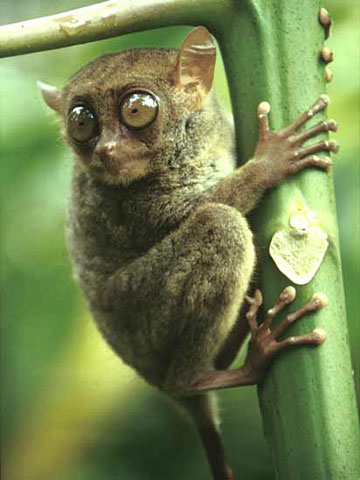
With its huge eyes, long tail, and hands and feet that must have inspired Steven Spielberg when he created E.T., the Philippine tarsier is almost Bohol's trademark. Still, few people have had the opportunity to have a close encounter with it.
The reason is twofold. Because it is a shy nocturnal animal that leads a mostly hidden life, it sleeps at daytime near the trunks of trees and shrubs deep in the impenetrable bushes and forests. They only become active at night, and even then, with their much better sight, and amazing ability to maneuver around trees are very well able to avoid us noisy humans well before we become aware of it's presence, so even when they were still present in abundance, the worlds of the tarsier and humans were mostly separated. But today, due to the quickly growing population, which causes more and more forests to be converted to farmland, housing areas and roads, the place where the tarsier can life it's secluded life is disappearing.
The tarsier is often claimed to be the world's smallest monkey -- however, this claim is somewhat dubious, since, although they are primates, technically, the tarsier is not a monkey. According to biology, it belongs to its own suborder under the primates, the prosimii or haplorrhini, while monkeys and apes belong to another suborder, that of the anthropods. Furthermore, even smaller primates have recently been in discovered on Madagascar: the adult pygmy mouse lemur weighs about 30 grams. But don't let this disillusion you, the Philippine tarsier is still a very special animal, well worth a day trip while you're on Bohol, and for some it is even the reason for their trip, and with an average 130 grams for an adult Philippine tarsier, it is still one of the smallest primates...
Although the species is believed to be about 45 million years old, and is perhaps one of the oldest land species to continuously live in the Philippines, it was only introduced to western biologists in the 18th century. The missionary J.G. Camel gave a description of the animal to J. Petiver, who published it in 1705, and named it the Cercopithecus luzonis minimus. Linneaus later renamed it to Simia syrichta, and later to the scientific name it still carries today: Tarsius syrichta. On Bohol, this little creature is known under a lot of names, often different from town to town, some of these local names are "mamag", "mago", "magau", "maomag", "malmag", and "magatilok-iok".
A Short History of Bohol (Part I)
IJsselstein, Thursday, 04 April 2002 04:44:43
Although people have been living on Bohol long before Magellan reached the islands that are now the Philippines, our written records start here, and about the events before that time, little is known, and has to be carefully reconstructed from oral traditions and archeological evidence.
It is said that around 1200, the Lutaos arrived from northern Mindanao. They build a settlement on stilts in the strait between mainland Bohol and the island of Panglao. This town later became a prospering local center of power, also known as the the "Kingdom of Dapitan." It lasted until it was abandoned in 1563, out of fear for raids by the Portuguese and their allies from Ternate. It will be seen below how this event helped the Spanish to get a foothold in the Philippines.
The Arrival of the Spanish
In 1521, Ferdinand Magellan and his crew were the first Europeans to reach the Philippines coming from the East. When they arrived they weren't really welcome: Magellan himself was killed on Mactan Island near Cebu, by the hand of a local chieftain or "Datu", Lapu Lapu.
Following Magellan's route, the Loaisa Expedition left La Caruña in Spain on 24 July 1525. This expedition also reached the Philippines, but on the first of June, 1526, a hurricane separated the ships. One of the ships, the Santa Maria del Parral, stranded on on the shore of North-East Mindanao. The survivors were captured and sold into slavery. One of the crew menbers, Sebastian de Puerto (or de Puerta), came in the hands of the Boholano chief Sikatuna. This is the first contact on record between a Spaniard and a Boholano.
More than forty years after Magellan's demise, in 1564, Spain sent out four expeditions to establish colonies in the Far East, and to pick up a share of the lucrative spice trade under control of the Portuguese. These expeditions failed, but in the next year, Miguel Lopez de Legazpi was more successful. Sailing westwards from Mexico with four ships and almost four hundred men, he reached the Philippines in the beginning of 1565, and established a Spanish settlement.
This wasn't an easy achievement. Just like Magellan before him, Legazpi met with hostile native warriors, who didn't like the idea of foreigers invading their islands. His attempt to land on the island of Cebu was twarted, and he decided to look for a friendlier place. He lifted his anchor and headed south in the direction of Mindanao. A change of wind, however, forced his fleet back to north in the direction of Bohol. With the help of a Mohammedan Malay pilot from a captured trading ship from Borneo, he learned that the Filipinos were involved in trade with the Moluccas, Borneo, Java, Malacca, and even far away places such as India and China.
The Blood Compact of Legazpi and Sikatuna
Also at Bohol, Legazpi was given a hostile welcome. From his Malay pilot, he learned that this hostility was due to maurading expeditions of the Portuguese. Coming from the Moluccas, the Portuguese raiders traversed the Visayan seas, and just a few years before, in 1563, had plundered Bohol and killed or enslaved about one thousand of its inhabitants. Of course, the Boholano's easily mistook the Spaniards for Portuguese.
Again with the help of his pilot, Legazipi explained two chiefs of Bohol, Datu Sikatuna of Bool and Datu Sigala of Loboc that they were not Portuguese, and had come in peace, and not to plunder or kill. This convinced the Kings to end their hostility and enter pact of friendship. On 16 March 1565 (or 25 March, records are confused due to the Georgian calender reform in 1584), Legazpi and Sikatuna performed the now famous blood compact, probably not far from the modern town of Loay. This event is still celebrated in Bohol every year in June with the Sandugo ("One Blood") festival. The same ceremony was repeated three days later with Sigala.
The Conquest of Cebu
After he assured himself of the aid of Sikatuna and Sigala, Legazpi decided to try to establish a permanent Spanish settlement on Cebu. With the native kings as guides, he lifted his anchor and left Bohol on Easter Sunday, and arrived at Cebu on 27 April 1565.
On the shore of Cebu, the local king Tupas already expected them. He had grouped his warriors in full battle array, ready to resist Legazpi and his invaders. In an attempt to negotiate a resolution of the impasse, a priest, father Urdaneta, went ashore, but he wasn't able to convince Tupas. Legazpi then initiated an attack. While the ship's artillery battered the coast, Spanish soldiers landed and attacked the Cebuano warriors. With their superior weapons the Spanish won a victory, and forced the troops of king Tupas to retreat to the hills.
After his defeat, king Tupas was more inclined to enter into peace negotiations. With the help of Cid Hamal, a Mohammedan Malay who stayed in Cebu at that time, a peace treaty was drawn up on the fourth of June 1565. In this treaty, king Tupas recognized the Spanish king as sovereign and agreed to pay a tribute, for which, in return, Legazpi promised to protect him against his enemies and to allow trade between the Filipinos and Spaniards. Also, Legazpi was granted a strategic site on Cebu, where he founded the first permenent Spanish settlement in the Philippines.
Establishment of Catholicism
In the footsteps of the Spanish explorers came the missionaries. About thirty years after the Spanish established themselves on Cebu, on 17 November 1596, two Jesuit priests, Father Juan de Torres and Gabriel Sanchez, arrived in Baclayon, Bohol. It is said that the mother of the encomendero of Bohol, Doña Catalina de Bolaños invited them. They established their headquarters in Baclayon, and quickly started to further spread the Catholic faith on the island.
Only a few years after the Jesuits' arrival, on 26 October 1600, Baclayon was raided by some 300 Maguindanao Moros commanded by Datu Sali and Datu Sirongan. In response, the Jesuits moved their headquarters to the inland town of Loboc, at a save distance from the coast. Since then, until the departure of the Jesuits from the Philippines in 1768, Loboc has been the residence of the local Jesuit superior. Here they also founded the first parish on the island in 1602, followed in 1604 by a school, the Seminario Colegio de Indios, a training school for the children of the local ruling class.
The Revolt of Tamblot
The new religion was not easily accepted by all. In the year 1621, Tamblot, a native priest or babaylan called upon the people to return to the faith of their forefathers, and to liberate themselves from the Spanish oppression. Around two thousand Boholanos joined him, and started a revolt when most of the Jesuit fathers where absent, celebrating the feat of the beautification of St. Xavier in Cebu.
When the news of the uprising reached Cebu, the alcalde-mayor Don Juan de Alcarazo, rushed an expedition to Bohol to supress it. on New Year's Day, 1622, an army of 50 Spaniards and over one thousand Filiponos started their campain against the rebels. In the following battle, fought out in a torrential rain at Malabago, Cortes, Bohol, the mayor was wounded and the Spanish had to retreat. Six months later, in a second attempt, the rebels where victorious again, but then some Spanish priests from Loboc managed to enter the camp of Tamblot and assasinate him. Then, Without their leader, the insurgents where easily defeated, and Spanish power was restored.
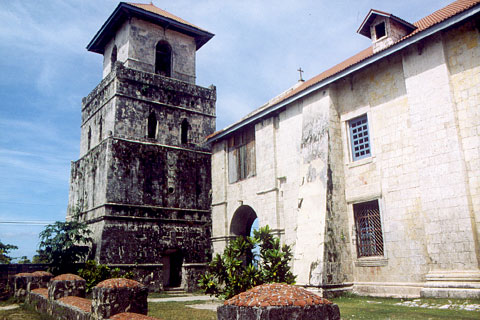
After these events, the Spanish more firmly established their power on Bohol. Using the labour of local workers, a number of magnificient stone churches where build, including the Church of Baclayon, which is one of the oldest stone churches in the Philippines, and was build, in its current shape in 1724, and the church of Loboc with its separate bell-tower.
By 1733, the Jesuits had established six settlements or reducciones: Loboc, Baclayon, Jagna, Talibon, Inabanga and Maribojoc. In these settlements, the people were forced to live together, so that it was easier to christianize them, as well as to collect taxes.
The Rebellion of Dagohoy
The oppressive methods of the Jesuits once more led to a serious insurrection against Spain. In the year 1744, Francisco Sendrijas alias Dagohoy started a revolt that was to last more than eighty nine years. The cause of this was an incident, in which the brother of Dagohoy was killed. Father Gaspar Morales, the Jesuit curate of Inabanga ordered a this brother, who was a constable, to capture a man who had left the Christian religion. The constable pursued the fugitive, but then was killed by him in a duel. However, when his body was brought back to town, the Jesuit refused the constable a Christian burial.
Infuriated at the priest, Francisco Dagohoy organised the people in an armed rebellion. The uprising started on 24 January 1744 with the killing of the Italian Jesuit curate of Jagna, Father Guiseppe Lamberti. Not long after that, Dagohoy also killed Father Morales, and the rebellion swept over the entire island. In vain, the Bishop of Cebu, Miguel Lino de Espeleta, attempted to calm down the situation, and restore Spanish rule. Dagohoy defeated the troops of Spanish and Filipino forces sent to subdue him. He established a free government in the mountains, and with his followers, was able to control much of the island. Even after Dagohoy's death, his rebellion continued, while the Spanish were only able to maintain their power in some settlements along southern coast.
In the span of 89 years, no less than twenty Spanish governors-generals, from Gasper de la Torre (1739-45) to Juan Antonio Martinez (1822-25), failed to surpress the uprising. In 1825, general Mariano Ricafort (1825-30), became governor-general of the Philippines. He send alcade-mayor Jose Lazaro Cairo to re-establish Spanish power in Bohol. With an army of 2,200 Spanish-Filipino men, he invaded Bohol on May 7, 1827. However, it took more than a year of fierce fighting, and another Spanish expedition under Capitain Manuel Sanz, who landed on Bohol in April 1828, before the patriots were defeated. He captured last remnants of Francisco Dagohoy's rebel forces from their hideout in the Cave of Caylagon. So, finally, by August 31, 1829, the rebellion was ceased. Most of the followers of Dagohoy were pardoned and resettled in new villages in the lowlands. These villages have now become the towns of Batuanan, Cabulao, Catigbian, and Vilar.
In the mean time, in 1768, the Jesuits had been expelled from the country, and their missions taken over by Augustinian Recollects headed by their former Provincial, Fray Pedro de Santa Barbara. Under their leadership, by 1800, the towns of Tagbilaran, Dimiao, Guindulman, Panglao and Loon had been founded.
A Short History of Bohol (Part II)
IJsselstein, Thursday, 04 April 2002 05:20:41
The Last Years of Spanish Rule
After the end of the Dagohoy rebellion, a period of relative peace starts in Bohol. During most of the Spanish era, Bohol was a part of the residencia of Cebu, but on 22 July 1854, it was made, together wit hthe island of Siquijor, into a separate politico-military province. In 1879, when a census was held, Bohol had 34 muncipalities and a total population of 253,103 souls. (Less than one fifth of the population today!)
Spanish rule came to an end in April 1899. In that year, after winning the American-Spanish war, the U.S. 'bought' the entire Philippines for twenty million dollars. The Spanish left the island, and Bohol became a "Gobierno de Canton," run by important Boholanos as part of the independent republic proclaimed by Emilio Aquinaldo.
The American Era
After almost one year, on 17 march 1900, American troops landed in Tagbilaran. Lead by Major Henry Hale of the 44th infantry Battalion, they came to take over control from the followers of Aquinaldo. The Boholanos started an organized resitance against the new invaders. On 3 September 1900, under the leadership of Col. Pedro Samson, a bloody struggle started, which lasted for several months. In their attempt to force the Boholanos to submission, the American forces burned to the ground 20 of Bohol's 35 towns, killed hundreds of people, and indiscriminately slaughtered livestock. Finally, on 23 December 1900, the resitance leaders surrendered to the Americans. A peace treaty was signed in the convent of Dimiao, and peace was restored. Unfortunately, a cholera epidemic following the turmoil of the war killed hundreds of Boholanos in the following year.
With the peace restored, the American government started to reorganize and reform much of the country. Roads were constructed and schools established, and the living conditions started to improve somewhat. It was also during this period, on 17 March 1917, that Bohol was created a separate province.
World War II
The American Era, effectively ended with the Second World War. On 17 May 1942, Japanese forces landed in Tagbilaran. Three very difficult years where to follow. Again, the Boholanos stood up to defend their freedom. The resistance movement, which constisted of disbanded soldiers and civilians, organized a guerilla style war against the Japanese oppression. At first, their headquarters, 'Behind the Clouds' was hidden in the deep and inaccessible ravines near Catigbian, and later this was moved to Carmen, while the original encampment remained a prisoners' camp.
The American forces returned on Bohol on April 11, 1945. This time, they were welcomed as liberators, and only to stay for a relative short time, as on the 4th of July, 1946, Bohol became a part of the independent Republic of the Philippines.
After Independence
After independence, a long period of relative peace and slow development started. Freedom loving and independent, Boholanos don't like to be ruled by others, and, unlike on many other islands in the Philippines, there are few large landowners or haciendas on Bohol. Many Boholano families were and still are subsistance farmers, who till their own small plots of land for their own food, and grow coconut trees for copra (dried coconut flesh), to earn money for their other needs. Although Bohol is still mainly an agricultural province, the capital Tagbilaran was elevated to a city on the first of July 1966, and today has a population of about 70.000 people. The entire province is now (according to the 2000 census) home to about 1.3 million people.
Like in many provinces in the Philippines, no longer all people can earn their livelyhood in agriculture, and many have sought a better future outside Bohol. Many have found work in the large banana and other plantations on Mindanao, or in the industry or in all types of service jobs in the big cities, especially Cebu and Manila. Boholanos are also well known as sailors. When on board a ship, both within the Philippines, or internationally, you have a big change that some of the crew members originally come from Bohol. Finally, a large number of Boholano's have moved abroad, to live and work in the Middle East, the United States, and Europe.
Only in recent years, the touristic potential of the island has been realized, and work has started to develop resorts and hotels to make Bohol's magnificient natural environment accessible for tourists.
The Philippine Tarsier
IJsselstein, Saturday, 24 April 2004 02:23:48
The Philippine tarsier, (Tarsius syrichta) is very peculiar small animal. In fact it is one of the smallest known primates, no larger than a adult men's hand. Mostly active at night, it lives on a diet of insects. Folk traditions sometimes has it that tarsiers eat charcoal, but actually they retrieve the insects from (sometimes burned) wood. It can be found in the islands of Samar, Leyte, Bohol, and Mindanao in the Philippines.
If no action is taken, the tarsier might not survive. Although it is a protected species, and the practice of catching them and then selling them as stuffed tarsiers to tourists has stopped, the species is still threatened by the destruction of his natural forest habitat. Many years of both legal and illegal logging and slash-and-burn agriculture have greatly reduced these forests, and reduced the tarsier population to a dangerously small size. If no action is taken now, the Philippine tarsier can soon be added to the list of extinct species.
Not "The World Smallest Monkey"
"The world's smallest monkey" is an often heard slogan. However, it is not a monkey. In truth, its classification is somewhat problematic. Some scienties consider tarsiers to be a taxonomic suborder among the primates. While, because they are closely related to lemurs, lorises and bushbabies, others classify them with the prosimians to which these animals belong. Monkeys and apes belong to the suborder of anthropoids. The complete taxonomic classification thus is:
Class Mammalia
Order Primates
Suborder Prosimii/Haplorrhini
Infraorder Tarsiiformes
Superfamily Tarsioidea
In the Philippines, three very similar species have been discribed. It is very well possible that these species are actually a single species, developed into three races due to the physical separation on the various islands.
Species Location
T. philippensis Samar and Leyte
T. fraterculus Bohol
T. carbonarius Mindanao
Outside the Philippines, a number of relatives of the Philippine tarsier can be found, among them the Bornean tarsier (Tarsius bancanus) of Borneo and Sumatra, the spectral tarsier (Tarsius spectrum), the lesser spectral tarsier or pygmy tarsier (Tarsius pumilus), and Dian's tarsier (Tarsius dianae) of Sulawesi, Indonesia. The pygmy tarsier, by the way, is considerably smaller than the Philippine tarsier, while the pygmy mouse lemur, found only in Madagascar, is now being recognized as the smallest primate in the world.
The tarsier was first introduced to Western biologists through the description given to J. Petiver by the missionary J.G. Camel of an animal said to have come from the Philippines (Hill, 1955). Petivel published Camel's description in 1705 and named the animal Cercopithecus luzonis minimus which was the basis for Linnaeus' (1758) Simia syrichta and eventually Tarsius syrichta. Among the locals, the tarsier is known as "mamag", "mago", "magau", "maomag", "malmag" and "magatilok-iok".
The species is believed to be about 45 million years old, dating back to the early Eocene period, and probably one of the oldest land species continuously existing in the Philippines.
Currently, the Philippine tarsier is categorized as a "lower risk, conservation dependent" species, which means that, although it is not yet categorized as vulnerable, endangered, or critically endangered, it could qualify for one of those categories within five years if the present protection programs are stopped.
Physical Description
General. The Philippine tarsier has a gray fur and a nearly naked tail. The middle finger is elongated. Head and body length are around 118-149 mm; It weighs 113-142 grams. Males are larger than females.
Eyes. In comparison with his body size, the eyes of the tarsier are enormous. In volume, the capacity of the bony eye orbits, or eye sockets, is larger than that of the brain case, and also larger than its stomach. Their eye sockets have post-orbital closure rather than the postorbital bar of the prosimians. This feature keeps the eyeballs from being pressed against by the powerful temporal muscles to their sides.
Tail. The tarsier has a relatively very long tail (232 mm), generally naked except for a tuft of hair at its end. The underside has dermal ridges like those found on human hands and feet. Its tail is used for balancing like a tripod; they prefer an erect posture at all times.
Head. Like an owl, the tarsier has a joint between its skull base and spine to allow head movement of a 180-degree arc. Its upper lip lacks a cleft yet, but still has muscles, so that it can make facial expressions. The adult brain weighs about 4 grams.
Teeth. Tarsiers have sharp teeth, enabling them to catch their prey easier. Unique among primates, tarsiers have only two, rather than four, incisors in their lower jaw. Their dental formula is 2.1.3.3 1.1.3.3 x 2 = 34.
Ankle bones. The name "tarsier" or "tarsius" is derived from the animal's very long ankle bones. The tibia and fibula of the tarsiers are fused in their lower portions, acting as a shock absorber. This is considered a primitive trait, which can normally be seen in quadrupeds. The lower limbs are twice the length of its trunk. These enable the tarsier to leap about three meters from tree to tree. Its movements are similar to that of a frog.
Comparison with other Primates. Tarsiers share some characteristics with both the prosimians and the anthropoids, while they also have some characteristics peculiar to themselves. Taxonomists have classified them as intermediate between both groups and have assigned them to their own infraorder, which contains just one living genus: Tarsius. Fossil records of this genus are found, dating back to the Eocene epoch, from 54 to 36 million years ago.
Like many prosimians, they are nocturnal and have grooming claws and bicornuate uterus.
Like anthropoids, they do not have a tapetum (a reflective layer in their eyes).
In tarsiers, the internal structures of the nose and ears and the blood supply to the brain and to a developing fetus are more like those of monkeys than of lorises. The monthly sexual swellings of female tarsiers are also similar to those in anthropoids.
Behaviour
Habitat. Tarsiers are arboreal. They live in and around the base of tree trunks and the roots of plants such as bamboo. They can occasionally be found in holes are at the top of trees. In Mindanao, tarsiers appear to thrive best in second or third growth thickets along the coast and in the valleys.
Behavior. The Philippine tarsier is nocturnal; they hunt at night, exclusively for animal prey. At day time, they hide in hollows close to the ground. When kept in captivity, individuals may huddle together or intertwine their tails. They are believed to live in groups, larger than just one male and one female. The female appears to take care for the young exclusively: no male parental care has been observed.
Diet. Tarsiers live exclusively on animal prey. Their diet includes primarily insects such as cockroaches and crickets, but may occasionally be extended with reptiles, birds, and bats. A Philippine tarsier in captivity will eat live shrimp and fish in a bowl of water.
Sounds. The tarsier produces a a number of different calls. The loud call is a loud piercing single note. When opponents meet, they produce a soft sweet bird-like trill. When several individuals communicate, they can produce a locust-like chirping. Females have a specials sound to indicate that they are fertile.
Scent Marks. Male tarsiers have epigastric glands, which they use for scent marking.
Reproduction. Females tarsiers have a prosimian-type uterus but a higher primate type placenta. One unusual feature is that they have multiple breast pairs, yet generally only the pectoral pair is functional. The other ones serve as anchoring points for newborn. The gestation period of a tarsier is about 180 days (6 months), and only one young is born at a time. When a tarsier is born, it is already in a well-advanced state of development. It is born well furred and with its eyes open. The head and body length at birth is 66-72 mm, the tail is 114-117 mm long, and its weight is 25-27 grams. They are able to move about after only two days. The mother carries infants with her mouth or on her belly. No nest is built. The female parks her infant while foraging. A young tarsier can climb after two days and jump after four. After about 19 days, young tarsiers already move around much like adults. It is breast-fed upto about 60 days. Juveniles tend to be more uniformly colored than adults. After two years, young tarsiers become sexually mature. The female has an estrus cycle, or recurring period of heat, of 23.5 days. Mating can take place any time of the year. Tarsiers can become 12 to 20 years old
posted by namzkie_baby @ 4:43 PM

0 Comments:
Post a Comment
<< Home